


IGS Site Visit
- Apr 22, 2021
- 7 min read
Intelligent Growth Solutions, Invergowrie, Scotland

The week before last, with thanks to Andrew Cumming and the team at IGS, two members of our team were invited to take a look at a fully operational vertical farm project located just outside of Dundee, and here is how it went....
“...Arriving at the James Hutton institute outside of Dundee, we were greeted by an eclectic mix of polytunnels, greenhouses, tractor sheds and admin buildings all spread out amongst each other, only a stones throw from the banks of the nearby River Tay.
After navigating a fairly complicated one-way system (it is a pandemic afterall), we suddenly found ourselves pointed towards a dirt road leading to what seemed like the rear of the site. After leaving the maze of buildings and tarmac behind, we continued down the track and up to a cluster of what seemed like portakabins in the distance. It was evident we had reached the land of start-ups, where money is tight and could see immediately where it was all going - a giant white structure that towers high above the fields and trees surrounding it. This concrete and steel megalith was the heart of the operation and contained the four futuristic vertical farming ‘towers’ we had come to visit.
After a friendly greeting with Andrew, we made our way across the yard to the rear of the main building, whilst fending off gusts from the blustery wind which was tearing around the Fife countryside that day. This area contained a series of polytunnels which we entered, and the first stage in the process of getting a seed to grow."

Step-by-step propagation..
"First of all, large plastic seed trays which hold roughly 200 seeds each are cleaned and filled with a growing medium or substrate (in this case dried, shredded coconut husk called 'coir'). The trays are then placed on a conveyor belt and fed into a special machine which sterilises using light and heat, before automatically inserting the correct number of seeds per tray using an air duct. The filled and seeded trays are then placed together in a very warm and humid germination room, whose atmosphere is closely monitored and controlled remotely. After a period of 10 days to 3-weeks (depending on plant type), the seeds begin to sprout roots and stems, meaning they are ready for the next phase of development."
The tour continues..
"We weaved amongst odd pieces of equipment and grey-clad workers pushing large metal trays whilst learning of these important steps in propagation. There is a constant cycle of maintenance carried out here only when it is needed, since the perpetually damp environment that plants crave for growth is detrimental for the machinery that houses them. This polytunnel area was an ideal place to assess the condition and carry out inspection of the large trays which make up the vertical tower structure itself, and this was underway all around us.
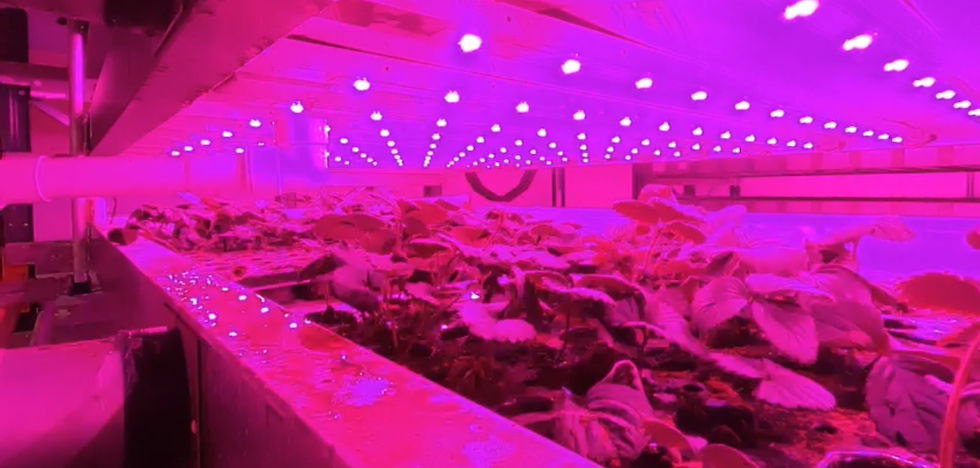
Each one had a large open top with a convex bottom for laying the plastic trays on and to provide correct distribution/drainage of water. Underneath there were long strips of LEDs which would shine on the tray below when properly stacked, and a clever device along each side which would be used to lift and secure them in place.
We followed one that was completely filled with black seedling trays and germinated plants, about to go into the next stage of the process – the growth tower."
Entering the tower..
"After reaching the door we had to wait our turn however, as there was an air lock system (told you it was futuristic), which could only hold one tray or a few people at a time. The reason for this is to create a negative pressure environment within the main building, which stops any bugs or insects from making their way inside and eating the crops.
Only about 20 seconds elapsed until we made our way inside and another step closer to the heart of the project.

The first thing to greet us upon entering besides utilitarian walls and flooring, was the absence of wind and the quiet hum of electricity. A number of TV screens were there displaying live sensor data and staff attendance for the day. Efficiency is a key part of the business and it’s importance in making things pay was stressed to us throughout the visit.
After a brief altercation with the automatic doors, we were inside the main hallway that spans the building and connects each of the towers."
A brief overview of the towers themselves..
"Think Amazon warehouse. Think B&Q. Think that bit before the tills at IKEA where you struggle to find the correct aisle for your furniture from the hastily scratched number you made earlier with one of those little pencils when you decided to buy that lamp because it was cheap so it didn’t really matter if the style clashes with the rest of your room. Think a big metal frame that reaches 9 m high and full of space for around 50 large rectangular shelves when full. Think concrete. Think steel.

The reality is actually not far from that vision of IKEA at all, as the duo who founded the company were researching automatic storage ideas for the Swedish company, who wanted to integrate it into their existing stock facilities. The pair then figured that filling each tray with plants and attaching a strip of lights to the underside of them wasn’t such a hard proposition. Apparently it wasn’t and they are now the highest (and as far as we know the only), operational proof of concept in the world utilising this method of vertical farming.
There are currently three out of four towers in use, with each segregated from the main lobby by rubber screens which help to isolate and maintain their respective environments. There are two racks of shelving per tower and in order to put each tray in position and then remove when harvesting, a belt driven lift in the centre of each stack is used.
They were testing one for maximum weight capacity when we arrived with the help of some sandbags and told us each lift could take up to 422 kg and that when a tray is full of mature plants and water, safety becomes a real factor since they had suffered a few scrapes on the way in the name of research and falling trays.
Which is entirely what the plants we seen growing are there for – research. Since IGS only design and construct the system for marketing towards any would-be vertical farmer, they must prove that whatever crop the customer intends to grow does so, and will continue to, providing an economic return on investment. The day we visited it was mostly a leafy green form of Asian cabbage, which tasted similar to kale. Sadly, there was no use for this end product even though it was a valuable food stuff, with each and every harvest being destined for the bin. Live outputs of pH levels and soil moisture content for each stack were shown on screens outside of each tower, with a bespoke amount of enriched air, food and water delivered to each tray."
The end of the visit..
"While inside the main hallway, we spoke to a technician who told us that until recently it was hard to even see inside the building since there was such a large infestation of flies and insects, the eggs of which were thought to be brought in with the peat substrate that was previously used. He was liberally spraying each tray with a nematode (small parasitic worm) solution as a preventative measure, hoping the tiny worms will hatch and eat the larvae of the flies before they can grow. Changing the substrate to coconut coir and the use of this organic insecticide obviously worked as there were no flies to be seen when we were there.
After a few more turns of watching the lift carry those precious trays full of green produce up and down, we made our way outside to the windier, colder and slightly smellier countryside of Fife that was home to this one of a kind project.”


Comments